Sub-second trades at consumer scale, 8.8 million of them
Over the past twelve months, roughly 8.8 million user operations have gone through Pimlico for fomo, across 14 mainnet chains. On the chains carrying most of that traffic, the median user operation confirms in under a second.
Just as important is what those trades do not contain. Nobody using the app sees a gas prompt, a token balance requirement, or a failed transaction they have to interpret. The trade is the whole interaction.
Mainstream traders will not learn gas, and will not wait
A retail user taps buy and expects it to happen. There is no version of that experience with a gas setting in it, and a trading app that asks for one will never reach past the people who already understand it.
Speed carries the same weight. A trading app lives or dies on fills, and a fill that takes seconds to land is simply a price that has moved. Both expectations fall on the same layer of the stack: the part that takes a signed intent and gets it onchain quickly, with none of the machinery showing.
Discovery and execution in the same place
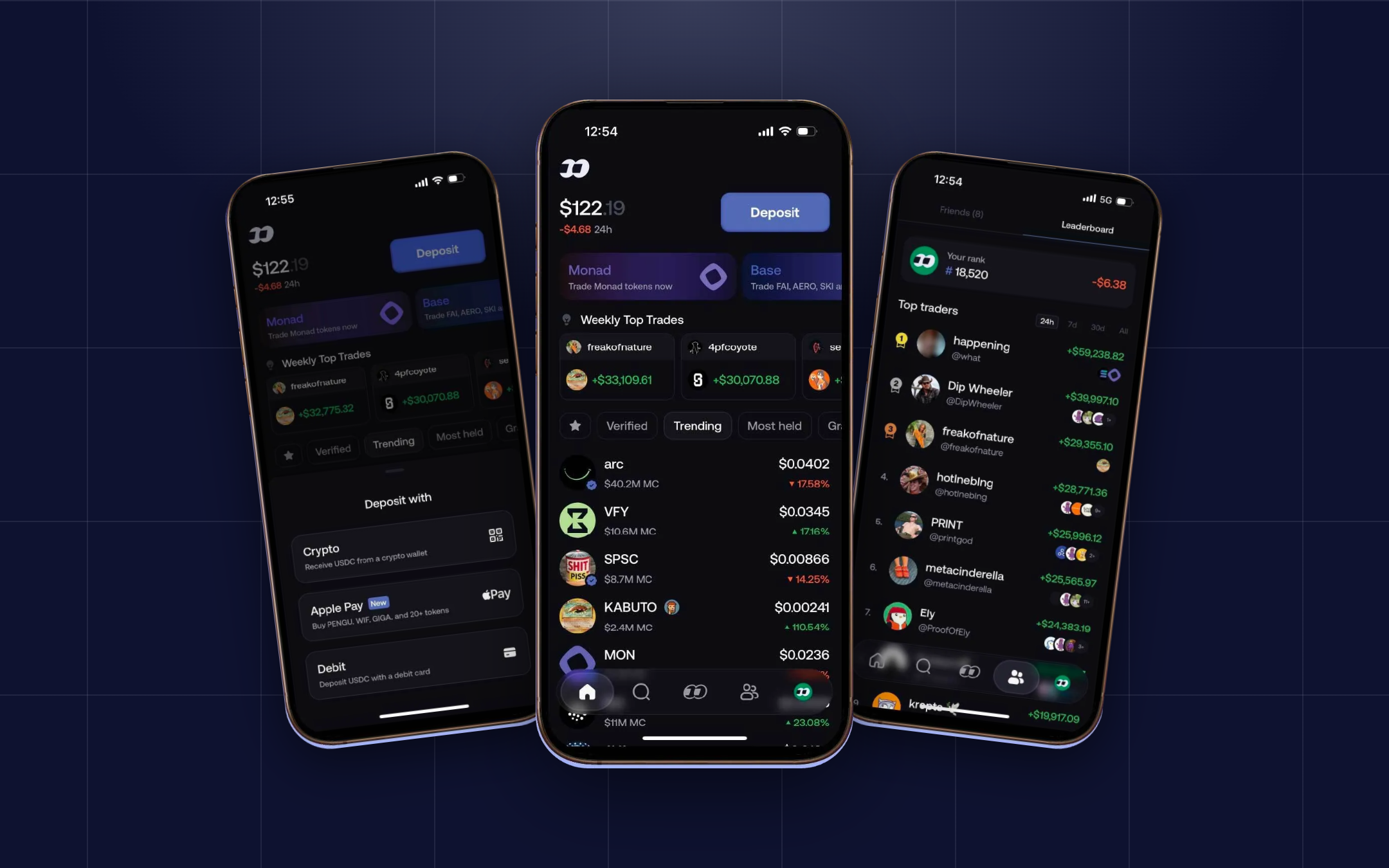
Trading on fomo starts with cryptocurrencies and perpetuals, with stocks and equities planned. The differentiator is the social layer: you can see what friends and other traders are buying, with positions, theses and the reasoning behind them sitting alongside the trade itself, plus a leaderboard of the traders worth watching.
That design reaches an audience most trading apps never touch. The app is built for anyone who wants to trade, not only for people already fluent in crypto, which is exactly why the transaction layer underneath it has to disappear.
Gas sponsorship, minus a lookup on the critical path
Pimlico sponsors gas on behalf of fomo's users, so no trade in the app ever surfaces the cost of settling it.
The latency gain comes from Pimlico's boosted paymaster. A conventional sponsorship flow measures gas on the client before a user operation goes out. The boosted paymaster removes that step, so a lookup drops off the critical path: less latency on every trade, and one less thing to get wrong. That combination, sponsorship plus a shorter path to inclusion, is what a consumer trading app actually needs from account abstraction infrastructure.
"Pimlico is one of our third-party vendors that we don't have to worry about at all and it saves us so much of our time."
Tina Zheng, Engineer, fomo
Why the transaction layer stayed out of house
Building the transaction layer in-house was considered at fomo, and the answer was to keep it with Pimlico.
"We decided that wasn't the best use of our resources. It's not something we need to specialise in as a company, and Pimlico was doing a really great job, so we didn't feel like we had to bring it in-house to make it any better."
Tina Zheng, Engineer, fomo
Fourteen chains and 8.8 million user operations later, that engineering time is still going into the product rather than the plumbing.
Want results like these? Tell us what you're building and we'll walk you through what Pimlico can take off your plate.
Book a call