A wallet people use without realising it is one
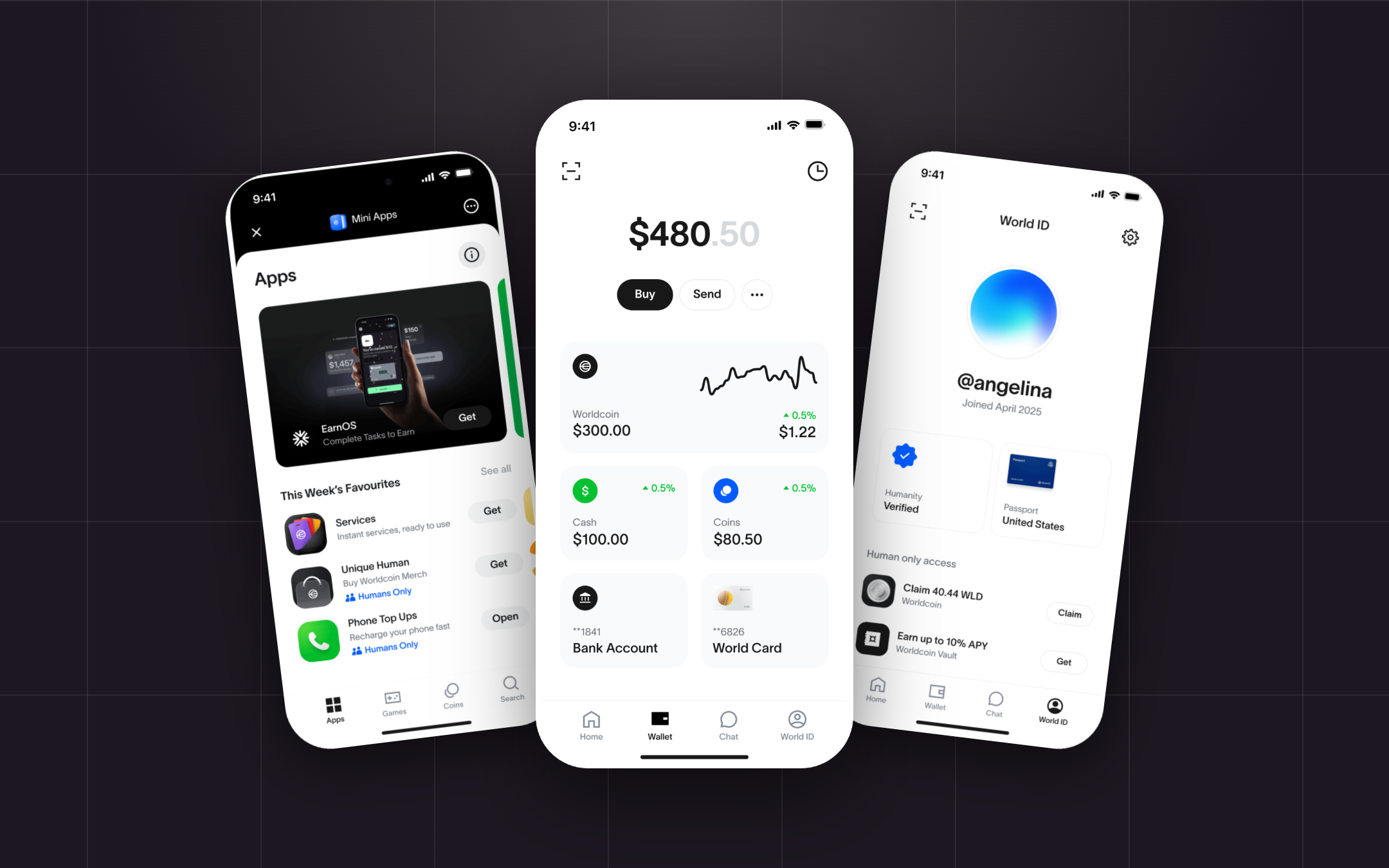
World App, built by Tools for Humanity, is a self-custodial wallet where the blockchain is abstracted away so completely that you can use the app without realising you are on crypto rails. Users get native wallet features (sending, trading, exchanging) and World ID. It is deliberately not a general-purpose wallet and does not connect to arbitrary dApps, so the transaction experience can be designed end to end.
Then there are mini apps, World App's third-party developer ecosystem. Developers submit a project, and once approved it appears in an app-store-like section of the app. Thousands of them, opened and used inside World App with the wallet already present. The abstraction has to hold across an entire ecosystem that the product team did not write.
The promise breaks at the first gas prompt
An invisible chain is unforgiving to operate. One moment asking a user to acquire a native token before they can act, and the abstraction is gone for that user, probably for good. Most user operations in World App cost the user nothing at all, so fees never reach the screen. When a user does choose to cover their own fees, that path has to be just as quiet: no checkout screen, no backend hop, no wait.
Multiply that across thousands of mini apps and millions of people, and the design goal becomes an infrastructure requirement: sponsored transactions at consumer volume, on the chain the product runs on, in the token the product uses.
A custom chain, supported early
World App runs on World Chain, a popular OP stack chain where transaction fees are a fraction of a cent. It is a custom chain, and custom chains are exactly the environment Pimlico's infrastructure is built for. Pimlico was one of the first teams to support World Chain. A team should not have to wait for its bundler and paymaster to catch up with the chain it chose.
A custom gas token, settled without the product in the middle
Users can also sponsor themselves by paying gas in an ERC-20 token, starting with WLD. Pimlico's ERC-20 paymaster settles that exchange directly between the user and the paymaster, atomically and onchain. Tools for Humanity's own services never sit in the payment path, and the token accepted is theirs to choose.
"What Pimlico offered was treasury management. Our services did not need to be in the way at all. For the user, everything would happen automatically."
Aurélien Brézun, Staff Software Engineer, Tools for Humanity
Support at the speed a custom stack demands
A custom chain and a custom gas token raise questions that no documentation page has anticipated. The only thing that helps then is a real answer arriving quickly, which makes response time part of the capability.
"It's a small team, so I can get an answer extremely fast when I need something. It's been a smooth ride. I don't know that I would change it."
Aurélien Brézun, Staff Software Engineer, Tools for Humanity
23 million user operations, and none of them show
Over the past twelve months, more than 23 million bundled user operations have gone through Pimlico for World App, with over 36 million sponsored. On World Chain the median user operation confirms in about 1.5 seconds, and better than nine in ten land inside about two seconds.
Sponsored transactions, self-sponsored ones in WLD, and a custom chain supported from early on: 23 million user operations later, none of it surfaces. Which was the whole idea.
Want results like these? Tell us what you're building and we'll walk you through what Pimlico can take off your plate.
Book a call